
The Infrastructure Shift: Memory Shortages, Custom Silicon, and the Rise of AI Services

- 🚀 Anthropic and Blackstone launch Ode, a $1.5 billion enterprise AI services firm built to bridge the gap between frontier models and real-world enterprise deployment.
- ⚙️ Meta accelerates its custom AI chip “Iris,” planning to begin manufacturing in September 2026 to double computing capacity and reduce reliance on external suppliers.
- ⚠️ SK Hynix warns of a severe AI-memory shortage by 2027, signaling that the AI compute race is becoming a memory bottleneck story as much as a GPU story.
- 🌐 Google DeepMind CEO Demis Hassabis calls for a US-led AI Standards Body to oversee advanced models and mitigate national security risks before AGI arrives.
- 🏢 TCS builds a massive forward-deployed AI engineering unit, planning to deploy up to 8,900 specialists to help clients implement AI systems in the field.
The focus of the AI industry is shifting rapidly from merely building capable models to deploying them effectively at enterprise scale. With major infrastructure investments, new enterprise AI service firms, and looming hardware bottlenecks, the tools for autonomous operations are maturing while the challenges of implementation take center stage. This week’s AI Doses covers the critical developments shaping the future of enterprise AI.

Breakthrough Research
2.1 The Looming AI Memory Bottleneck
Problem Addressed: The rapid scaling of AI infrastructure has primarily focused on securing GPUs, but the immense data processing requirements of advanced AI systems are creating new constraints in the supply chain.
Technical Innovation: SK Hynix, a leading memory chip manufacturer, warned that the industry could face its worst-ever supply shortage in 2027, driven by sustained AI demand for high-bandwidth memory. The company’s CEO stated that demand is set to outstrip supply beyond 2030.
Architecture Implications: The AI compute race is evolving from a pure GPU shortage to a broader infrastructure challenge where memory capacity and bandwidth become the primary constraints on scaling frontier models.
Enterprise Relevance: Enterprises planning long-term AI deployments must factor in potential hardware shortages and price inflation (“chipflation”) when designing their AI infrastructure strategies.
Future Direction: We will see increased investment in memory optimization techniques and alternative architectures designed to reduce the memory footprint of large-scale AI models.
2.2 Meta Accelerates Custom AI Silicon Production
Problem Addressed: Hyperscalers face massive costs and supply chain vulnerabilities by relying heavily on third-party GPU providers like Nvidia and AMD for their AI computing needs.
Technical Innovation: Meta is set to begin manufacturing its custom AI chip, code-named “Iris,” in September 2026. Designed in collaboration with Broadcom and TSMC, the chip aims to help Meta double its computing capacity to 14 gigawatts by 2027. Bug-testing completed in just six weeks with no major issues.
Architecture Implications: The move toward in-house silicon by major tech firms indicates a shift toward vertically integrated AI infrastructure, where hardware is custom-designed for specific platform workloads.
Enterprise Relevance: While enterprises may not build their own chips, the diversification of AI hardware could eventually lead to more competitive pricing and varied compute options in the cloud market.
Future Direction: The hyperscaler custom silicon trend will intensify, potentially reshaping the competitive dynamics of the semiconductor industry and lowering the long-term cost of AI inference.
2.3 Gemini 3.5 Pro Undergoes Full Pre-Training Rebuild
Problem Addressed: Developing reliable agentic models capable of complex, recursive tool-calling and long-context reasoning remains a significant engineering challenge, even for leading AI labs.
Technical Innovation: Google DeepMind reportedly scrapped its initial Gemini 3.5 Pro base model and undertook a full pre-training rebuild after the original version struggled with complex scene layouts and recursive tool-calling environments. The rebuilt model is targeting a mid-July release.
Architecture Implications: The decision highlights the difficulty of moving from conversational AI to reliable agentic execution. It suggests that patching models via post-training is insufficient for fundamental structural gaps in reasoning capabilities.
Enterprise Relevance: Enterprises building autonomous workflows should carefully evaluate models based on their performance in recursive tool-calling scenarios rather than general benchmarks.
Future Direction: The industry will increasingly differentiate between speed-optimized models for high-volume tasks and deep-reasoning models for complex, multi-step execution.
Industry & Strategy Intelligence
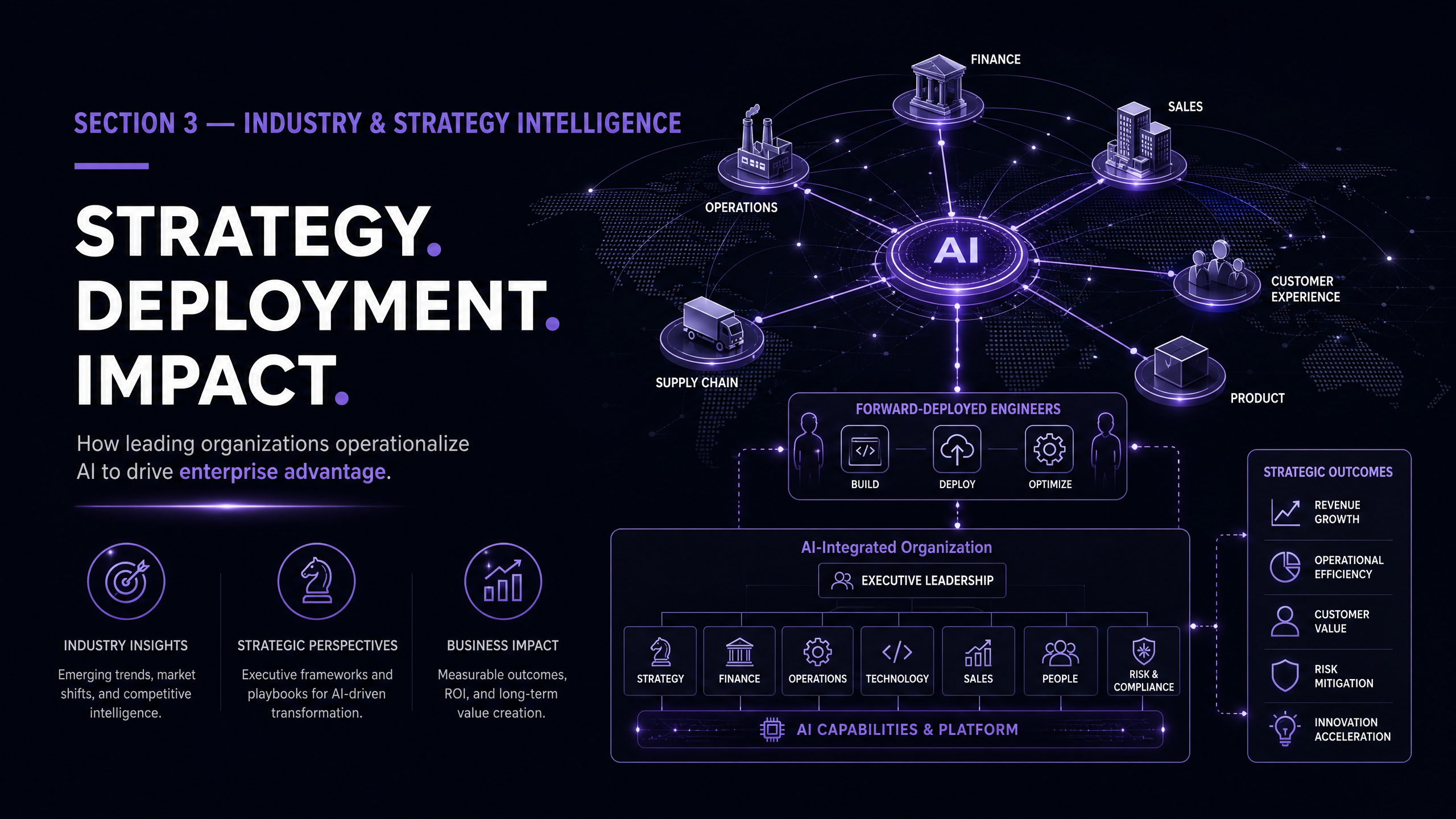
3.1 Anthropic and Blackstone Launch Ode: The $1.5B AI Services Firm
What Happened: Anthropic, Blackstone, and Hellman & Friedman introduced “Ode with Anthropic,” a $1.5 billion enterprise AI services firm. Built on the foundation of Fractional AI, Ode embeds elite forward-deployed engineers inside enterprises to implement AI solutions using a “Claude-first” principle.
Industry Impact: This joint venture underscores a growing realization among AI labs that winning enterprise customers requires more than shipping better models — it requires hands-on engineering to integrate those models into complex business workflows.
Enterprise Relevance: Enterprises struggling to move from AI pilots to production can leverage specialized services like Ode to bridge the implementation gap and achieve measurable ROI.
Strategic Observation: The “deployment gap” is the new frontier of competition. Technology providers are increasingly partnering with enterprises to engineer outcomes, signaling the rise of the AI services industry.
3.2 TCS Builds Massive AI Deployment Engineering Unit
What Happened: Tata Consultancy Services (TCS) announced plans to build a forward-deployed engineering group of up to 8,900 specialists dedicated to helping clients implement AI systems in the field, while also pursuing AI acquisitions.
Industry Impact: This move by India’s largest IT services firm indicates a structural redesign of the outsourcing business model around AI deployment rather than traditional cost-cutting services.
Enterprise Relevance: Large enterprises will have access to massive scale when deploying AI across their organizations, supported by established IT partners pivoting to AI-first service models.
Strategic Observation: The demand for AI implementation is so vast that both elite boutique firms (like Ode) and massive global system integrators (like TCS) are aggressively expanding their forward-deployed engineering capabilities.
3.3 Demis Hassabis Calls for US-Led AI Standards Body
What Happened: Google DeepMind CEO Demis Hassabis called for the creation of a US-led AI Standards Body to oversee advanced models and assess national security risks, warning that humanity has a “precious window” to ensure AGI is safe. He proposed a FINRA-like, industry-funded body.
Industry Impact: The proposal reflects growing pressure from AI leaders for formalized, industry-funded regulatory structures to manage the risks associated with frontier models and eventual artificial general intelligence.
Enterprise Relevance: Enterprises must prepare for a future where advanced AI models are subject to rigorous testing, mandatory reviews, and potential deployment restrictions based on security assessments.
Strategic Observation: As AI capabilities approach AGI, governance is shifting from theoretical discussions to concrete proposals for regulatory institutions, similar to those in the financial industry.
Tools, Products & Platform Spotlights
Muse Spark 1.1 — Meta
What It Does: A multimodal reasoning model optimized for agentic tasks, tool use, coding, and long-context workflows, now available in public preview via the Meta Model API.
Enterprise Use Cases: Developing agentic applications and integrating multimodal reasoning capabilities into enterprise platforms using an open-weight model ecosystem.
Key Benefit: Provides developers with direct access to Meta’s frontier stack, offering an alternative to closed ecosystems for building custom agentic infrastructure.
Agent Architecture Multimodal AI Open Ecosystems
ChatGPT Work — OpenAI
What It Does: An enterprise-grade agent system powered by GPT-5.6 that can gather information across apps, generate finished materials (documents, decks, websites), and execute multi-step tasks autonomously over extended periods.
Enterprise Use Cases: Automating complex knowledge work, from data analysis and document creation to cross-application workflow orchestration that previously required dedicated human effort.
Key Benefit: Transforms the chatbot interface into a persistent, action-oriented agent capable of executing ambitious projects, staying with a task for hours if needed.
Productivity Autonomous Agents Enterprise Workflows

Podcasts Worth Your Time
Lex Fridman Podcast #497 — “Dario Amodei: Anthropic CEO on Claude, AGI & the Future of AI”
Anthropic CEO Dario Amodei discusses the state of the AI race, the development of Claude, scaling laws, and the path to AGI. An essential listen for understanding the strategic vision driving one of the world’s leading frontier AI labs — especially timely given the launch of Ode this week.
Hard Fork (NYT) — “The Deployment Gap: Why Building AI Is Easier Than Using It”
Kevin Roose and Casey Newton explore the latest developments in AI infrastructure, including Meta’s push for custom chips and the growing realization that implementing AI is becoming harder than building the models themselves. Sharp, accessible analysis of the week’s most important AI developments.
No Priors — “The 2026 AI Forecast with Sarah & Elad”
Sarah Guo and Elad Gil break down major trends in the 2026 AI landscape, discussing the rapid adoption of AI in professional services, the rise of agentic systems, and the evolving economics of AI infrastructure. Essential listening for enterprise leaders navigating the AI services market.

Webinars & Events
Find the AI You Don’t Know You Have: An Architecture-Driven Playbook for AI Discovery
A crucial session for security and enterprise architecture teams on discovering and inventorying shadow AI and approved AI systems across the enterprise — establishing the foundation for risk analysis, governance, and compliance with emerging AI regulations.
AMD Advancing AI 2026
Hear the AMD AI strategy and get up to speed on the latest AI compute innovations. Meet enterprise customers investing in AI and developers building the next generation of AI infrastructure — directly relevant given this week’s hardware shortage discussions.
Agentic AI Summit 2026
A two-day summit bringing together 5,000+ attendees from academia, industry, policy, and venture to explore the latest trends in agentic AI, multi-agent systems, and autonomous enterprise functions. Keynotes, technical talks, panels, workshops, and live demos.
Ai4 2026: America’s Largest AI Conference
The epicenter of the global AI industry, connecting 12,000+ attendees from 90+ countries with 1,000+ speakers and 400+ exhibitors. Explore real-world AI deployments, infrastructure strategies, and enterprise case studies across three days of intensive content.
Future Trends & Market Opportunities
The Deployment Gap Creates a New AI Services Industry
Why Now: The launch of Ode by Anthropic and Blackstone ($1.5B) and TCS’s commitment to field up to 8,900 AI deployment engineers send a clear message: enterprises have access to powerful AI but lack the expertise to deploy it. The bottleneck is no longer model capability, but implementation.
Enterprise Preparation: Build internal “Forward Deployed Engineering” capabilities or partner strategically. Focus on the integration layer — how AI connects to proprietary data, legacy systems, and daily operations. The winners will be those who master the engineering required to embed AI into their core operations.
Infrastructure Constraints Shift from Compute to Memory
Why Now: SK Hynix’s warning of a severe memory shortage by 2027 signals that the AI hardware race is broadening. As models process larger context windows and run continuous inference loops, high-bandwidth memory becomes a critical chokepoint alongside GPU availability.
Enterprise Preparation: Optimize AI workloads for memory efficiency. When designing agentic systems, prioritize architectures that minimize unnecessary token generation and context bloat to manage long-term infrastructure costs as “chipflation” spreads through the supply chain.
Vertical Integration in AI Hardware Accelerates
Why Now: Meta’s move to manufacture its custom “Iris” AI chip demonstrates that hyperscalers are aggressively moving to reduce their reliance on third-party silicon providers. This vertical integration aims to lower costs and tailor hardware to specific platform needs.
Enterprise Preparation: While most enterprises won’t build custom chips, prepare for a more fragmented cloud compute market. Design AI architectures to be hardware-agnostic, allowing flexibility to leverage the most cost-effective compute options as new silicon enters the market.
Expert Quote & CEO Strategic Insight
“The rapid progress we’re seeing in AI requires a new approach to testing frontier AI model capabilities that is dynamic, adaptable, and rigorous. The US is well positioned, given its economic and technical standing, to take the first step in developing such a framework.”
🎯 CEO Strategic Insight — The Deployment Imperative
This week’s developments confirm a structural shift in the AI industry: the era of simply marveling at model capabilities is over. We have entered the era of the “Deployment Imperative.”
The launch of Ode by Anthropic and Blackstone, backed by $1.5 billion, and TCS’s commitment to field up to 8,900 AI deployment engineers, send a clear message. The technology is ready, but the enterprise architecture is not. Organizations are realizing that buying an API key or a SaaS license does not automatically translate into business value. Value is created through the hard, unglamorous work of integration — connecting AI to messy legacy systems, navigating complex data governance, and redesigning human workflows.
Simultaneously, the physical constraints of AI are becoming apparent. Warnings of memory shortages and the race for custom silicon remind us that AI is not magic; it runs on highly constrained physical infrastructure.
For enterprise leaders, the mandate is clear:
- Invest in Integration: Shift your focus from evaluating the latest models to building the connective tissue. The winners will be those who master the engineering required to embed AI into their core operations.
- Optimize for Efficiency: Anticipate rising infrastructure costs. Design your AI systems to be efficient in both compute and memory usage.
- Prepare for Governance: As calls for formal AI standards bodies grow louder, proactive governance is no longer optional. Build robust frameworks for AI auditability and risk management today.
The future belongs to the integrators.
— Founder & CEO, Neotheta | AI | Strategy | Product Innovation

Ready to Move Beyond AI Experimentation?
At Neotheta, we help enterprises transform AI from isolated pilots into scalable business capabilities. Whether you’re defining an AI strategy, building AI governance frameworks, modernising data & AI platforms, developing AI-native products, or scaling agentic AI initiatives — our team helps organisations translate emerging AI technologies into measurable business outcomes.
