
AI Infrastructure Race: Custom Silicon, Open-Weight Frontier Models, and the Agentic Enterprise
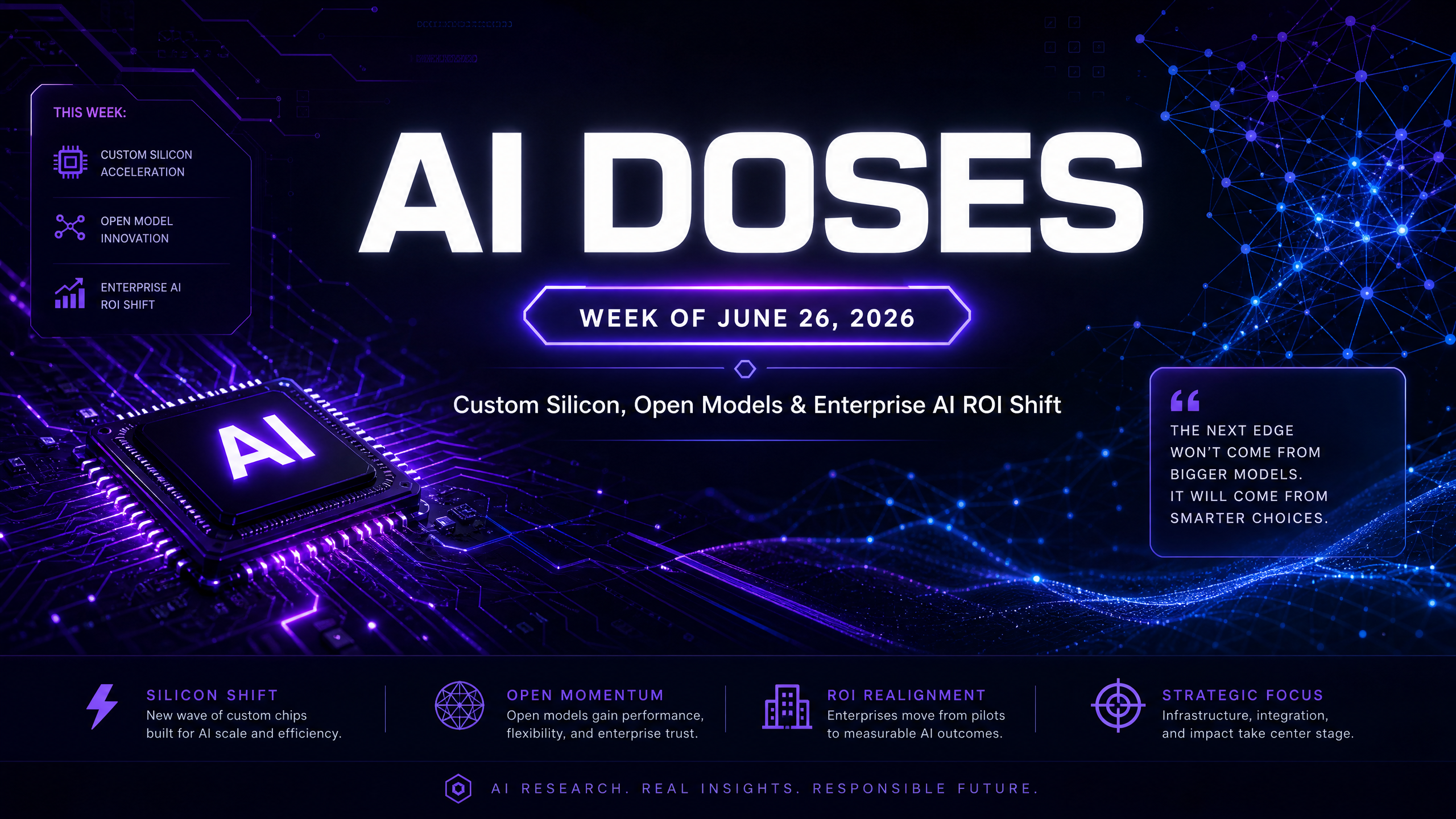
The AI arms race is moving down the stack to custom silicon, while open-weight models challenge frontier dominance, and enterprises demand measurable ROI from agentic deployments.
🏗️ OpenAI and Broadcom unveil Jalapeño, a custom AI chip optimized for LLM inference to reduce dependency on Nvidia.
🏛 Z.ai releases GLM-5.2, an open-weight frontier model trained without Nvidia hardware, highlighting the shift toward model-agnostic strategies.
🤖 Samsung Electronics rolls out ChatGPT Enterprise and Codex globally, marking one of the largest enterprise AI deployments to date.
⚖️ OpenAI research shows non-developer adoption of Codex is outpacing developer adoption, as agentic AI transforms the nature of knowledge work.
📊 Anthropic finds domain expertise rivals coding background in agentic coding success, democratising AI-driven software development.
The organizations that succeed over the next three years will not simply adopt AI faster — they will build the infrastructure, governance, and operating systems required to scale it safely. This week’s AI Doses explores the signals every technology and business leader should be watching.
Breakthrough Research

2.1 Z.ai Releases GLM-5.2, an Open-Weight Frontier Model
Problem Addressed: Enterprises have historically traded ownership and control for frontier model performance, creating vendor lock-in and data residency challenges, exacerbated by hardware supply constraints.
Technical Innovation: Z.ai released GLM-5.2, an MIT-licensed open-weight mixture-of-experts model with a one-million-token context window. Independent testing places it near the closed-model frontier for coding, notably trained without Nvidia hardware.
Architecture Implications: The performance gap between open and closed models continues to collapse. Enterprises can now run frontier-level models entirely on their own infrastructure, eliminating data residency bottlenecks and hardware dependency.
Enterprise Relevance: Organizations should shift toward model-agnostic orchestration, utilising open-weight models for sensitive workloads while maintaining closed models for edge cases, reducing reliance on single-vendor APIs.
Future Direction: Open-weight AI is no longer a compromise but a strategic advantage for cost optimisation, data governance, and vendor independence.
2.2 OpenAI and Broadcom Unveil Jalapeño Inference Chip
Problem Addressed: The cost and availability of inference compute have become major bottlenecks for scaling AI applications, with heavy reliance on a single hardware vendor.
Technical Innovation: OpenAI and Broadcom introduced Jalapeño, a custom AI chip built specifically for LLM inference. Designed from scratch in nine months, it aims to improve performance, efficiency, and scale across AI systems.
Architecture Implications: AI labs are moving down the stack to control their hardware destiny. Custom silicon optimised for specific inference workloads will become critical for unit economics.
Enterprise Relevance: As inference costs drop, the feasibility of deploying long-running, autonomous agents at scale increases dramatically. Enterprises should prepare for more ubiquitous AI integration.
Future Direction: Expect increased vertical integration among major AI providers, leading to more competitive pricing and diverse hardware ecosystems.
2.3 Anthropic Finds Domain Expertise Rivals Coding Background in Agentic Coding
Problem Addressed: The assumption that agentic coding tools are only beneficial for trained software engineers limits their potential impact across an organisation.
Technical Innovation: An analysis of 400,000 Claude Code sessions revealed that domain expertise predicts task success more reliably than a software-engineering background, with non-software professionals reaching verified success on coding tasks at 26%, close to engineers at 30%.
Architecture Implications: Agentic tools are abstracting away the syntax of coding, elevating the importance of problem definition and domain knowledge.
Enterprise Relevance: The productivity gap between engineers and domain experts using agentic coding tools is shrinking. Organisations can empower subject matter experts to automate their own workflows.
Future Direction: A shift toward operating software rather than writing it, suggesting these tools are maturing into general software-operations platforms.
Industry & Strategy Intelligence

3.1 Samsung Deploys ChatGPT Enterprise and Codex Globally
What Happened: Samsung Electronics is deploying ChatGPT Enterprise and Codex to its employees worldwide, including all Korea employees and global Device eXperience (DX) division staff.
Industry Impact: This marks one of the largest enterprise AI rollouts to date, signalling a shift from isolated pilot programmes to company-wide, operational AI platforms.
Enterprise Relevance: The deployment spans technical and non-technical work, from R&D and manufacturing to marketing and corporate functions, illustrating the broad applicability of agentic tools like Codex.
Strategic Observation: Successful enterprise AI adoption requires moving beyond specialised teams and embedding AI as a core platform for all employees, supported by robust security and governance frameworks.
3.2 OpenAI Reports Agents Are Transforming Work
What Happened: A new economic research paper from OpenAI highlights how agentic AI is changing knowledge work from single interactions to delegated, long-horizon tasks.
Industry Impact: At OpenAI, Codex has become the primary AI tool across all departments, including Legal and Finance, with non-developer adoption growing 137x since August 2025.
Enterprise Relevance: Over 80% of users are making requests estimated to exceed 30 minutes of human work. Agentic tools are expanding the horizon of potential productive work for non-technical employees.
Strategic Observation: Businesses must redesign workflows and training programmes to leverage agentic AI, as employees transition to orchestrating multiple agent tasks rather than simply querying chatbots.
3.3 The Real Bottlenecks Holding Back Enterprise AI
What Happened: Despite high enthusiasm, many enterprise AI projects stall due to data readiness and governance issues, as discussed in recent industry analyses.
Industry Impact: The transition to autonomous agentic workflows is underway, but success is bottlenecked by data infrastructure. Agents acting on unverified or stale data present significant operational risks.
Enterprise Relevance: A Harvard Business Review study cited in recent podcasts notes that only 7% of enterprises believe their data is actually ready for AI.
Strategic Observation: The companies getting AI right are fixing their data discipline first. Security and governance must shift left, moving closer to the data source.
Tools, Products & Platform Spotlights

4.1 Anthropic Ships Live Artifacts and Centrally Managed Auth for Claude Code
What It Does: Anthropic brought Artifacts to Claude Code, turning coding sessions into live, shareable browser pages. They also launched Enterprise-Managed Authorisation for MCP connectors.
Enterprise Use Cases: Collaborative coding, stakeholder review, and secure, centralised IT management of third-party integrations.
Benefits: Centralised identity gives IT and security teams the controls needed before rolling out multi-agent systems, solving a major friction point for enterprise adoption.
4.2 Lenovo Expands Hybrid AI Advantage Portfolio
What It Does: Lenovo announced an expansion of its Hybrid AI Advantage portfolio, introducing new AI inferencing platforms and agentic AI tools in collaboration with NVIDIA, Intel, Red Hat, and Canonical.
Enterprise Use Cases: Deploying autonomous AI where data is created — on PCs, in data centres, or in the cloud — while reducing inference costs.
Benefits: Helps enterprises deploy AI closer to their data and business processes, optimising performance, cost, security, and governance.
Podcasts Worth Your Time

Why the Frontier Ecosystem Must Be Open — Matei Zaharia and Reynold Xin, Databricks
Databricks cofounders Matei Zaharia and Reynold Xin discuss Omnigent, LTAP, and why databases may matter more than ever once AI agents start doing real work. A deep dive into the infrastructure required for enterprise agents.
Enterprise AI Data Infrastructure Agentic AI
The Real AI Advantage Isn’t What You Think
Exploring Artificial Intelligence & Enterprise AI with World Wide Technology. The discussion highlights that while everyone claims to be data-driven, only a small fraction of enterprises have data truly ready for AI, emphasising the critical role of data readiness.
Enterprise AI Data Strategy AI ROI
The Real Bottlenecks Holding Back Enterprise AI with Justin Borgman
Justin Borgman, Co-Founder & CEO at Starburst, discusses the real bottlenecks holding back enterprise AI, focusing on data infrastructure, quality, and the challenges of moving from experimentation to execution.
Data Architecture Enterprise AI Implementation
Webinars & Events

The State of AI Proficiency in the Enterprise
A comprehensive session covering the foundational aspects of AI adoption, focusing on measuring and improving AI proficiency across the workforce.
AI Strategy Enterprise Adoption AI Literacy
How to Build an AI-Native Supercompany
A leadership summit focused on transforming organisations into AI-native entities, covering strategy, culture, and operational changes required for the agentic era.
Executive Leadership AI Strategy Business Transformation
AI4 2026 — America’s Largest AI Conference
Join thousands to explore real-world applications, breakthrough advancements, and proven best practices driving AI forward across every industry.
AI Applications Industry Trends Networking
Momentum AI Austin 2026
A tightly curated, invite-only forum built exclusively for enterprise AI decision-makers. Focuses on turning AI into a defensible, scalable operating capability.
Executive Leadership Enterprise AI Networking
Future Trends & Market Opportunities

Vertical Integration in AI Infrastructure
Why Now: The introduction of OpenAI’s Jalapeño chip and Z.ai’s hardware-agnostic GLM-5.2 model highlight a shift away from single-vendor hardware dependency.
Enterprise Preparation: Evaluate infrastructure strategies to ensure flexibility. Cloud and hardware diversity will become a key risk mitigation strategy against supply chain constraints.
The Rise of the Domain Expert Developer
Why Now: Anthropic’s research shows domain experts are nearly as successful as software engineers when using agentic coding tools.
Enterprise Preparation: Democratise access to agentic tools across business units. Empower subject matter experts to automate workflows and build internal tools, shifting the IT role from bottleneck to enabler.
Agentic Orchestration as the New Operating System
Why Now: As seen with Databricks’ Omnigent and Microsoft’s Copilot strategy, the focus is shifting from individual models to orchestration layers that manage agents, context, and permissions.
Enterprise Preparation: Invest in data readiness and governance platforms that can securely feed context to multiple AI agents. The competitive advantage will lie in proprietary data and the orchestration layer, not the underlying LLM.
Expert Quote & CEO Strategic Insight

“The model was never the problem. A secure model fed bad data still produces bad outcomes. The live threat for most companies isn’t a rogue AI model. It’s bad, ungoverned, non-consented data flowing into systems that now act on it automatically. The companies getting AI right fixed their data discipline first.”
This insight highlights the critical bottleneck in scaling agentic AI. As organisations deploy autonomous agents, the focus must shift from model selection to data governance and infrastructure readiness.
🎯 CEO Strategic Insight — The Infrastructure and Orchestration Imperative
The Enterprise AI Agent Deployment Checklist is evolving rapidly from model selection to infrastructure and orchestration.
This week’s developments — OpenAI designing custom inference chips, Z.ai proving frontier capabilities without Nvidia hardware, and Samsung rolling out agentic tools globally — signal a maturing market. The focus is no longer just on which model is smartest, but on how efficiently and securely intelligence can be deployed at scale.
Simultaneously, the realisation that domain experts can wield agentic coding tools almost as effectively as engineers fundamentally changes the ROI equation for enterprise AI. We are moving from AI as a specialised IT tool to AI as a ubiquitous operational platform.
Organisations now face a strategic imperative:
- Prioritise Data Readiness: Agentic systems are only as reliable as the data they consume. Fixing data discipline and governance is the prerequisite for scaling AI.
- Embrace Orchestration: Invest in platforms that can manage multiple agents, route workloads dynamically, and maintain strict security and access controls.
- Democratise Agentic Tools: Empower your domain experts with AI capabilities to automate workflows and drive innovation from within business units.
The enterprises that build robust, governed AI infrastructure today will be the ones capable of safely unleashing the full potential of autonomous agents tomorrow.
— Founder & CEO, Neotheta | AI | Strategy | Product Innovation

Ready to Move Beyond AI Experimentation?
At Neotheta, we help enterprises transform AI from isolated pilots into scalable business capabilities. Whether you’re defining an AI strategy, building AI governance frameworks, modernising data & AI platforms, developing AI-native products, or scaling agentic AI initiatives — our team helps organisations translate emerging AI technologies into measurable business outcomes.
